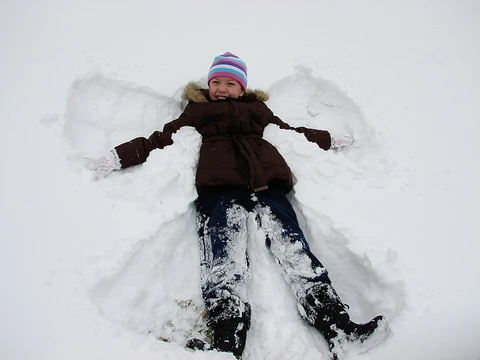
Snow angel
A simple snow design made by moving limbs in fresh snow.
A snow angel is a pattern pressed into fresh snow. To make one, a person lies on their back and moves their arms up and down while swinging their legs side to side, creating an angel-like shape. The process starts with finding a flat, untouched area of fresh snow. After lying down with arms and legs spread out, the limbs are swept back and forth to carve troughs. The finished design looks like a stylized angel: the arm movements form wings, and the leg movements create a gown. Light, powdery snow works best for this, unlike heavy or sticky snow.
- technique
- Find undisturbed fresh snow, lie down, sweep arms and legs
- best snow type
- Fresh, light, powdery snow
- world record holder
- North Dakota (8,962 snow angels, February 17, 2007)
- previous record holder
- Michigan Technological University (3,784)
- non-human examples
- Pheasants, Weddell seals
Lore & Background
The snow angel is created through a straightforward process: first, find an undisturbed plane of fresh snow. Then lie with arms and legs outstretched on the snow, and sweep the limbs back and forth to form a trough. When finished, the snow angel should have the appearance of a stylized angel, with wings formed by the arms and a gown formed by the legs. Fresh, light, powdery snow is preferred over heavy, sticky snow for the best result.
Reader's Guide
The snow angel is a simple, widely recognized winter activity, often associated with play and childhood. Its significance lies in its accessibility and the brief, ephemeral art it creates in snow. The world record for the most snow angels created simultaneously in one place is held by North Dakota, with 8,962 made on the state capitol grounds in Bismarck on February 17, 2007, confirmed by Guinness World Records on March 28, 2007. The previous record was held by Michigan Technological University with 3,784 participants. Non-human animals, such as pheasants and Weddell seals, also leave similar figures in snow or ice. The snow angel has appeared in popular culture, including a Norwegian hit song 'Engler i sneen' (1989), an episode of The Simpsons, the film Love Story (1970), Piglet's Big Movie, and an Elliott Smith song 'Angel in the Snow'.
Did You Know?
- The world record for most snow angels created simultaneously is 8,962, set in Bismarck, North Dakota on February 17, 2007.
- Fresh, light, powdery snow makes the best snow angel rather than heavy, sticky snow.
- Weddell seals leave outlines of themselves, similar to a snow angel, melted into the ice, called seal shadows.
- The snow angel appears in the 1970 film Love Story, created by a character played by Ali MacGraw.
Frequently Asked Questions
What is a snow angel in popular culture?
A snow angel is a decorative impression left in fresh snow when a person lies flat and sweeps their limbs outward, producing a shape that resembles a winged, robed figure. It is one of the most recognizable seasonal symbols associated with winter play.
How do you actually make a snow angel?
You locate a flat, untouched patch of fresh snow, lie on your back with arms and legs spread wide, then sweep your arms up and down while swinging your legs side to side to carve the wing and gown shapes into the surface.
What kind of snow works best for a snow angel?
Light, powdery snow gives the cleanest, most defined impressions. Heavy or sticky snow tends to smear and lose the crisp edges of the wing and gown details.
What is the world record for snow angels?
North Dakota set the record on February 17, 2007, by creating 8,962 snow angels in a single event. That surpassed the previous mark of 3,784 held by Michigan Technological University.
Can animals make snow angels too?
Yes—pheasants and Weddell seals have been observed making similar limb-sweeping impressions in snow, producing shapes that look remarkably like the classic human snow-angel design.
More in Angels in popular culture 1-24
Spotted an error? Know more?
This is a living reference — every entry is fact-audited, and reader corrections feed straight into our audit queue. Suggest an edit · See this site's audit record